
.png?width=50&name=Untitled%20(400%20x%20400%20px).png)

If you're a small business owner trying to grow without feeling overwhelmed, you're not alone.
If you have ever thought, “I’m not a writer,” you are not alone.
One of the most common concerns I hear from small business owners is this:
“I’m not good at writing.”
“My grammar isn’t great.”
“I wouldn’t know where to start.”
So the idea of writing blog posts for your business can feel intimidating before you even begin.
But here is the truth.
You do not need to be a writer to create helpful, effective blog content. You need to understand your clients and care about helping them.
Everything else can be supported.
Why writing blog posts feels harder than it should
When people think about long form content, they often picture:
- Perfect grammar
- Polished paragraphs
- Clever headlines
- Something that sounds impressive
That pressure is usually what stops them.
But blog posts are not about being literary. They are about being useful.
Your clients are not looking for perfect prose. They want clarity. They want reassurance. They want someone to explain a problem and help them move forward.
That is something you already do every day in conversations.
The only difference between a conversation and a blog post is that one is written down.
You already know what to say
If you run a service-based business, you are constantly:
- Answering questions
- Explaining your process
- Breaking down complex ideas
- Reassuring clients
- Sharing lessons from experience
That is content.
The challenge is rarely a lack of knowledge. It is the blank page and the belief that it needs to be perfect.
It does not.
So instead of asking, “How do I write a blog?”, a better question might be:
“How do I capture what I already say in a way that feels manageable?”
A simple process that removes the pressure
This is the process I use myself and teach my clients.
1. Start with real client questions
Do not begin with trends or what feels impressive.
Start with what your clients are already asking you.
Choose a topic based on repeated conversations, or ask ChatGPT to suggest ideas based on your ideal client and services.
The strongest blog posts come from real needs.
When you start there, the writing becomes much easier.
2. Get your thoughts down first
Do not try to write a finished blog straight away.
Instead:
- Write bullet points
- Talk it out in your own words
- Record a voice note and transcribe it
- Jot down the main points you want to cover
Messy is fine. This stage is thinking, not publishing.
A messy page is much easier to work with than a blank one.
3. Use ChatGPT to shape and structure
Once your ideas are down, you can ask ChatGPT to:
- Turn your notes into a clear blog structure
- Improve grammar and flow
- Suggest anything helpful you might have missed
- Keep the tone aligned with how you naturally speak
When used like this, ChatGPT is not replacing your voice. It is organising your thinking.
You remain the expert. It simply helps you articulate what you already know.
4. Review and refine
You stay in control.
Read it through.
Adjust wording so it feels natural.
Remove anything that does not sound like you.
Add personal insight where needed.
It is still your blog post. The tool just helps you get there more efficiently.
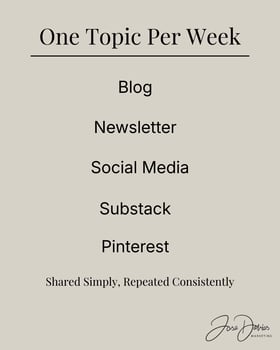
Make it simpler: one topic per week
There is another piece that makes this far more sustainable.
You do not need endless ideas.
In my Roadmap to Revenue programme, I teach a very simple framework.
One topic per week.
Choose one topic that reflects:
- A question your ideal client is asking
- A problem they are experiencing
- A concern you hear repeatedly
Write one clear blog post around that topic.
Then let that single piece of thinking do more work.
That same topic can become:
- The spotlight story in your newsletter, linking back to the blog
- A Substack post
- Several social posts pulled from key sections
- A Pinterest pin that directs readers to the article
Instead of constantly creating new content, you deepen one idea.
This reduces pressure, improves consistency, and keeps your message clear.
Long form content becomes far less intimidating when it is not “another thing to produce”, but the centre of your weekly marketing.
One topic.
One blog.
Shared in a few simple ways.
That is sustainable.
Why long form content matters
When you approach it this way, blog writing stops feeling like performance and starts feeling like communication.
Writing blog posts consistently helps you:
- Build trust
- Improve search visibility
- Demonstrate expertise
- Support your sales process
It allows people to understand how you think.
And when the process feels manageable, you are far more likely to keep going.
Content does not need to be perfect to be effective. It needs to be clear, human, and useful.
Before you start, set ChatGPT up properly
One final point.
ChatGPT works best when it understands you.
If you open a new chat each time and simply ask it to “write a blog”, the result will often feel generic. That is usually when people say, “This doesn’t sound like me.”
The difference comes from setting it up properly.
When you take the time to personalise it, clarify your tone, explain your business, and define how you want to use it, it stops being a random tool and starts becoming a consistent thinking partner.
That is exactly why I created a short guide called:
“Set Up ChatGPT for Success.”
It walks you through how to personalise ChatGPT so it understands your work and tone, the essential prompts to use, and how to structure it so it supports your marketing consistently.
If you want ChatGPT to genuinely support your content creation rather than frustrate you, start there.
You can download the free guide here: Your Chat GPT Guide
You already know what your clients need. You already have the insight.
With the right structure and support, writing blog posts for your business becomes far less intimidating and far more achievable.